Secular Ambitions: Before his religious life, Luigi Gentili was a charismatic and ambitious young man in Rome. A graduate in law, he moved in high social circles, learned multiple languages, and sought prestige, even securing the title “Knight of the Golden Spur.”
Personal Crisis: His secular life came to a halt after a failed romance. A young English lady he wished to marry was sent away by her guardian, leaving him disheartened and prompting a spiritual re-evaluation.
Meeting Rosmini: This crisis led him to Antonio Rosmini, the founder of the new Institute of Charity. Rosmini recognized Gentili’s potential and became his spiritual mentor. Under Rosmini’s guidance, Gentili’s impulsive and romantic nature was forged into a disciplined, focused, and spiritually deep character prepared for apostolic work.
2. The Mission to England and its Historical Context
Arrival in 1835: Father Gentili arrived in London in June 1835, significant in the “Second Spring” of English Catholicism.
A New Era: His mission was made possible by the Catholic Emancipation Act of 1829, which had removed the penal laws against Catholic missionaries.
Concurrent Religious Movements: Gentili’s work took place at the same time as the Oxford Movement, a high-church Anglican movement whose members were re-examining their Catholic roots. Gentili would eventually interact with and influence key figures from this movement.
3. Character, Preaching, and Missionary Methods
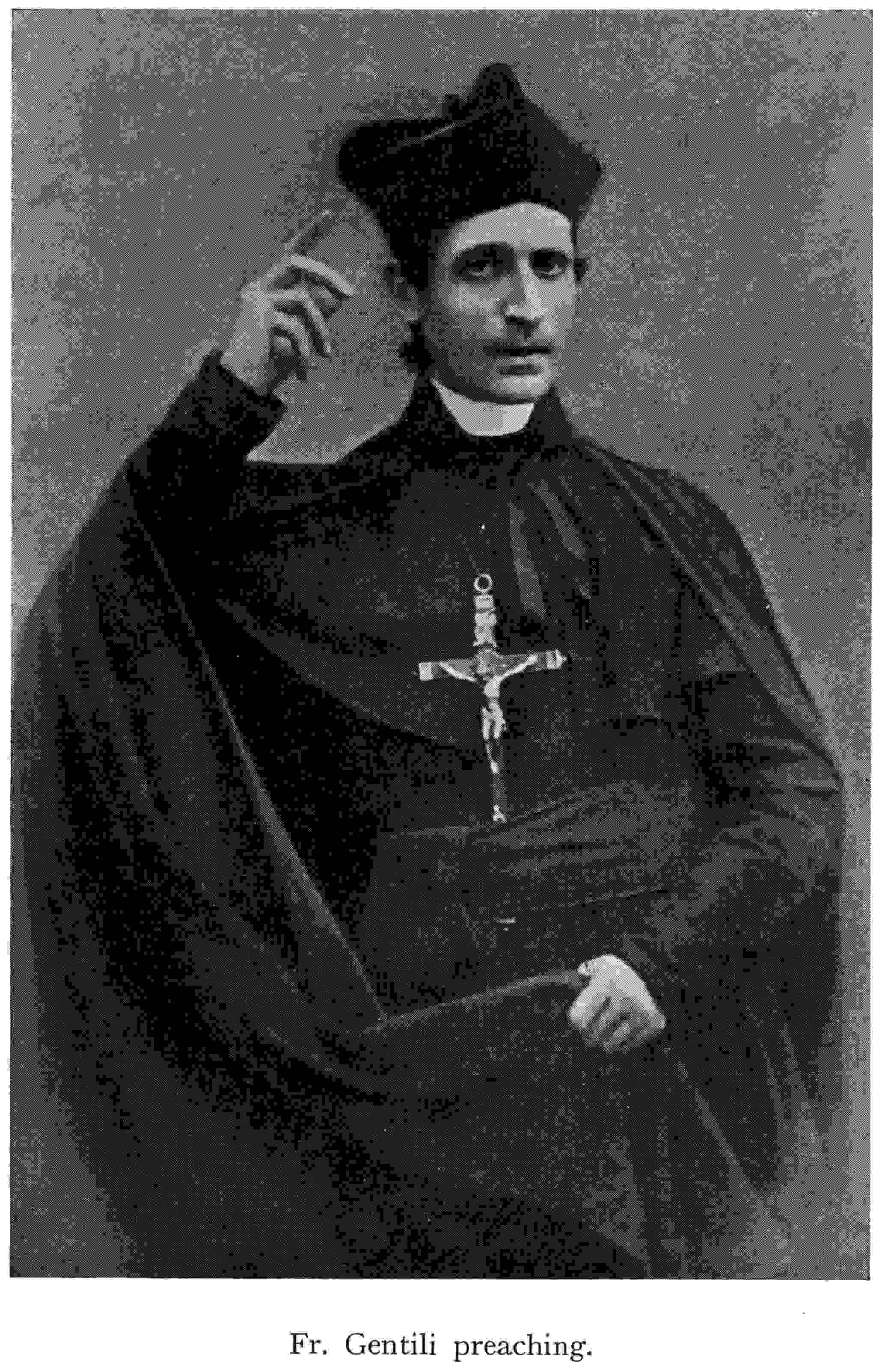
A Powerful Preacher: Gentili was described by contemporaries as an extraordinary and compelling preacher. His influence stemmed from his perceived holiness, “unflinching honesty,” courage in confronting mobs and prejudice, and a speaking style that conveyed deep conviction.
Reviving Catholic Fervour: His mission had two main goals: converting Protestants to Catholicism and re-energizing the faith of existing Catholics, who had been forced to practice their religion discreetly for centuries.
Introducing Catholic Devotions: Gentili and his fellow Rosminians are credited with introducing several practices that became staples of Catholic life in England, including:
Popular parish missions.
The Forty Hours’ Adoration (Quarant’ Ore).
Devotions for the Month of May.
The public renewal of baptismal vows.
The use of the Roman collar by clergy.
4. Influence on the Oxford Movement and William Lockhart
Contact with Newman’s Circle: Gentili came into contact with members of the Oxford Movement, including John Henry Newman and his community at Littlemore.
The Conversion of William Lockhart: In 1843, William Lockhart, a young man living with Newman, converted to Catholicism under Gentili’s guidance and joined the Rosminian order.
A Catalyst for Newman: Lockhart’s conversion was a pivotal moment. It deeply affected Newman, who felt he could no longer hold his Anglican position and resigned from St. Mary’s, Oxford. This event is presented as a key step that broke Newman’s state of indecision and pushed him towards his own conversion two years later.
5. Adviser on the Restoration of the English Hierarchy
Secret Reports to Rome: In 1847, Gentili was tasked by the Vatican’s Sacred Congregation of Propaganda Fide to write a series of confidential reports on the state of the Church in England.
Advocating for Dioceses: Drawing on his extensive experience, he argued strongly for the urgent need to restore the formal Catholic hierarchy (a system of dioceses with bishops) to replace the existing structure of vicariates.
Influential Recommendations: His detailed reports and practical suggestions were well-received by Pope Pius IX and played a significant role in the eventual restoration of the English Hierarchy in 1850.
6. Final Mission in Ireland and “The Supreme Sacrifice”
Work During the Famine: Gentili felt a deep connection to Ireland and worked there with great energy, particularly during the Great Famine. He preached to raise funds for the starving and provided spiritual comfort.
Intense Missions in Dublin: In 1848, he began a series of protracted missions in Dublin that produced extraordinary spiritual results, drawing thousands to the confessional.
Death from Fever: While preaching in one of Dublin’s unhealthiest districts, he contracted a fever. He died on September 26, 1848, at the height of his missionary success. His death was seen as the ultimate sacrifice for his flock.
Legacy and Veneration: His funeral was a major public event in Dublin, and he was buried with great honor in the O’Connell Circle at Glasnevin Cemetery. His remains were later moved to Omeath.